The Demoscene: Digital Art's Unsung Vanguard Earns Global Stage
From its humble origins in 1980s software cracktros to gaining UNESCO cultural heritage status, the demoscene stands as a testament to digital creativity and technical artistry.
AI-generated image
What if code wasn't just functional, but an expressive medium in itself, pushing the boundaries of what computers can do in real-time? That's the core question the demoscene has been answering for decades, a vibrant digital art subculture that has quietly thrived, transforming technical prowess into stunning audiovisual experiences. Far from a niche curiosity, this community has recently earned significant recognition, solidifying its place not just in computing history but in cultural heritage itself.
Born from the home computer revolution of the early 1980s, the demoscene's roots are intertwined with the nascent software cracking movement. Early crackers, eager to claim credit for removing copy protection, began attaching small introductory screens—dubbed "cracktros"—to their modified software. These started as simple text screens, as seen on the Apple II, but quickly evolved into more elaborate animated displays with music, fostering a competitive drive for the most impressive visual presentation. This rivalry soon led to the creation of stand-alone programs, eventually known as "demos," which showcased pure technical and artistic skill, independent of any pirated software. By 1986, groups like 1001 Crew and The Judges on the Commodore 64 were crafting original demos that truly pushed hardware to its limits, birthing the demoscene as we know it.
The Paradox of Constraint: Fueling Innovation
At its heart, a demo is a self-contained, real-time audiovisual application designed to demonstrate the capabilities of the machine it runs on, and by extension, the skills of its creators. Unlike pre-rendered animations, everything in a demo—from intricate 3D graphics to pulsating music—is generated on the fly by code. This dedication to real-time execution under often severe constraints is what defines the craft. Demos are frequently categorized by size, with typical competition categories including the 64k intro and the 4K intro, restricting the executable file size to 65536 and 4096 bytes, respectively. Other competitions might limit the choice of platform, focusing on 8-bit computers like the Atari 800 or Commodore 64, or 16-bit systems such as the Amiga or Atari ST. These limitations are not arbitrary; they are the crucible in which demosceners forge their creativity. The tighter the constraint, the more ingenious the solutions, pushing coders, musicians, and graphics artists to make hardware perform beyond its original design. This philosophy fundamentally shapes the demoscene's unique aesthetic and technical prowess, turning what some might see as restrictions into catalysts for innovation.
Creating these technical and artistic marvels is often a group effort. Demosceners typically organize into small groups, bringing together diverse talents such as coders (programmers), musicians, and graphicians (graphics designers). While individuals can choose to do everything themselves, it is common practice for sceners to specialize in one role, outsourcing others to their group mates. This collaborative spirit, often likened to a team sport, leverages individual strengths in programming, mathematical understanding, graphical artistry, and musical composition to achieve a shared creative vision that would be impossible alone. It's a testament to how collective human ingenuity thrives under shared, self-imposed challenges.
Demoparties: The Stage for Digital Artistry
Demoscene releases typically occur at demoparties—gathering events that bring sceners together for two to three days. These events feature a series of competitions, or "compos," where entries are displayed on large screens, voted upon by attendees, and winners receive symbolic prizes. Demoparties are vibrant melting pots of creativity, described as a fusion of a music festival, a sports tournament, and a 24/7 art exhibition and workshop. The motivation for participants extends beyond competition; it's about learning, improving skills, collaborating, and experiencing the unique rush of seeing one's art piece displayed on a concert-sized screen with booming sound in front of a cheering crowd of thousands. These gatherings are the lifeblood of the demoscene, fostering community, competition, and the direct appreciation of real-time digital art.
Beyond these intense gatherings, the demoscene has achieved significant cultural recognition. In 2020, Finland notably added its demoscene to its national UNESCO list of intangible cultural heritage, marking it as the first digital subculture to receive such an honor. This was followed by similar acknowledgments from Germany and Poland in 2021, the Netherlands in 2023, and with Sweden and France in 2025. This international recognition, championed by initiatives like "Art of Coding," underscores the demoscene's profound impact as a transnational digital culture that combines programming, artistic experimentation, and community collaboration. It signifies not only the official validation of a unique art form but also a broader acknowledgment of the cultural value embedded in digital creativity and the mastery of code.
More from Scene & Code
- The Browser Became the Canvas: How Web Tech Reshaped the Demoscene
- Size Coding's Enduring Fascination: The Art of Extreme Compression
- Tiny Games, Big Lessons: Why Web Developers Embrace Constraints
- Beyond OpenGL: Why WebGPU Is Poised to Reshape Graphics Development
- Demoparty Titans: How Assembly and Revision Define the Scene
- The Kilobyte Symphony: How Tiny Files Make Big Demoscene Sounds
- Shader Art is More Than Code: It's a Performance Revolution
- Graphing Calculators: The Unlikely Canvas of a Digital Art Form
No topics yet: start the first one.
More stories
Cyberpunk 2077 Film: Can It Code the Demoscene Spirit into the Big Screen?
CD Projekt Red's choice for an original *Cyberpunk 2077* film narrative presents a golden opportunity to embed the game's radical digital art ethos, but only if it dares to embrace the demoscene's rebellious spirit beyond mere aesthetics.
Twitch's Unexpected Canvas: Why Demoscene and Creative Coding Thrive Live
Beyond its gaming roots, Twitch has cultivated a vibrant, interactive home for live coding, fostering real-time collaboration and community growth among demoscene artists and creative programmers.
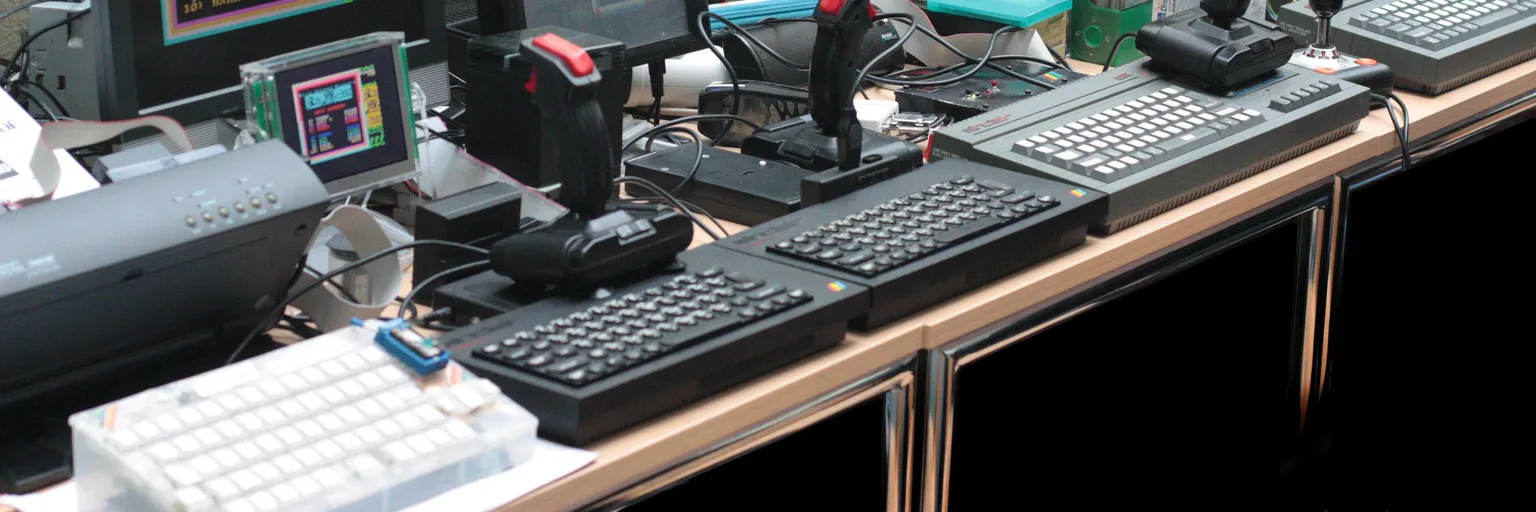
Why the ZX Spectrum Demoscene Still Compels Creative Coders
Mark Dastmalchi-Round's recent ZX Spectrum demoscene intro illustrates how stringent retro hardware limitations ignite ingenuity and push creative boundaries in the modern era.
Size Coding's Enduring Fascination: The Art of Extreme Compression
In an era of boundless storage, the demoscene's size-coding artists continue to push boundaries, crafting complex visual and auditory experiences within minuscule byte limits, proving ingenuity trumps gigabytes.