Shader Art is More Than Code: It's a Performance Revolution
Fragment shaders have transformed digital art from static images into dynamic, real-time performances, pushing creative coding into an engaging spectacle for audiences worldwide.
AI-generated image
Can digital art truly be a live, competitive sport, as immediate and thrilling as a rap battle? For a growing community of creative coders and demosceners, the answer is a resounding yes, driven by the expressive power of fragment shaders. What began as a technical component in graphics pipelines has evolved into a vibrant art form, transforming pixels in real-time and captivating audiences with its blend of mathematical precision and spontaneous creativity.
At its core, this artistic revolution centers on fragment shaders, a computational technique offering unparalleled control over every pixel on a screen at remarkable speeds. These aren't just tools for rendering; they're effectively a Gutenberg's press for graphics, allowing for non-serial, simultaneous pixel manipulation. This capability has fueled creative platforms like Shadertoy, where artists share their GLSL experiments, and the high-octane live-coding competitions known as Shader Showdown, now a staple at demoparties.
The Pixel as a Performance Stage
Fragment shaders run on the GPU, giving creators total command over individual pixels. This means that instead of a step-by-step painting process, a shader calculates all pixels simultaneously, producing images in seconds that might take hours with traditional methods. This parallel processing power makes shaders ideal for everything from cellphone video filters to complex 3D video games, and critically, for the kind of instantaneous visual feedback demanded by live coding. The OpenGL Shading Language (GLSL) serves as the lingua franca for this domain, enabling developers and artists to weave procedural shapes, patterns, textures, and animations directly into the fabric of the digital canvas. The ability to see changes immediately, through interactive examples found in resources like The Book of Shaders, is fundamental to learning and experimenting with this potent technique.
Sculpting Virtual Worlds with Math
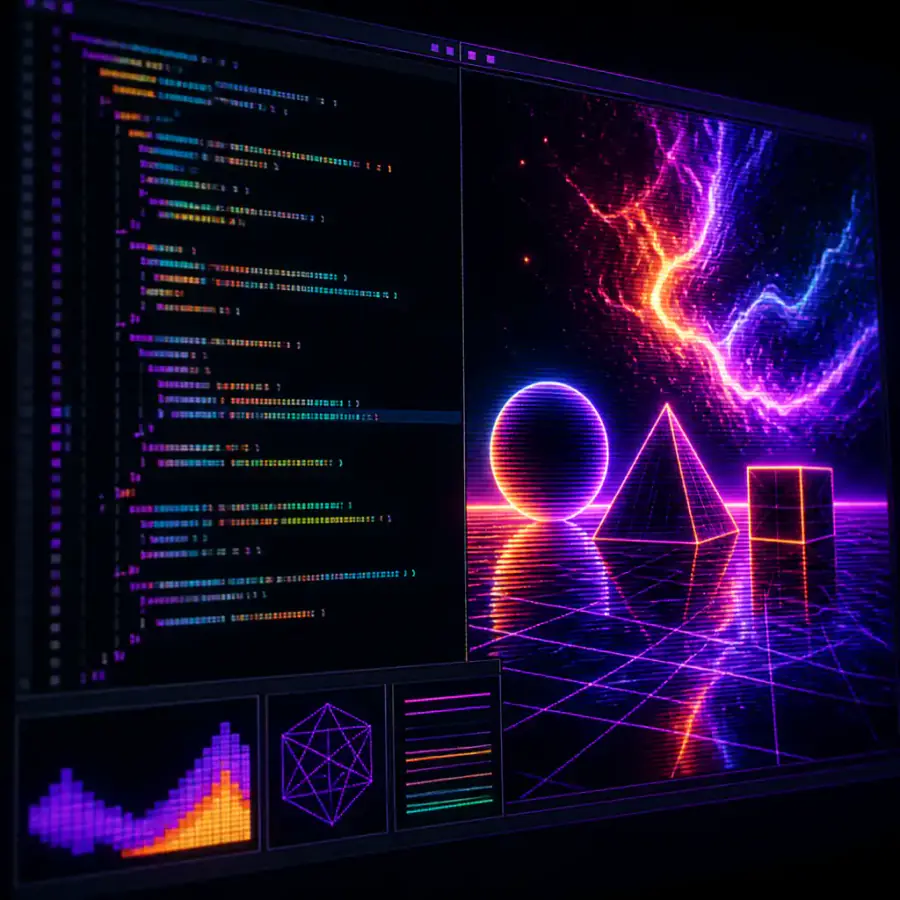
Beyond basic effects, fragment shaders enable advanced techniques that blur the line between mathematics and art. Raymarching, often combined with Signed Distance Fields (SDFs), stands out as a particularly powerful method for generating complex 3D scenes and objects purely through mathematical functions. Instead of explicitly defining geometry with polygons, artists define shapes by functions that describe the shortest distance from any point in space to the surface of an object. This allows for intricate details and organic forms that can be manipulated and rendered in real-time. Pioneers like Inigo Quilez, known for his contributions to Shadertoy, have showcased the incredible potential of raymarching to create stunning, often surreal, digital landscapes and animated figures with concise code. It’s a testament to how abstract mathematical concepts can become the chisel and hammer for digital sculptors.
Shader Showdown: E-sports Meets Artistic Expression
The demoscene, a global community of artists and programmers creating real-time audiovisual applications since the late 80s, has fully embraced shader art as a competitive performance. The Shader Showdown, which gained popularity after its debut at a Polish demoparty in 2013, epitomizes this fusion. Two performers code from memory on stage, starting from a blank screen and having only 25 minutes to create an impressive visual effect, often using tools like Bonzomatic. Accompanied by a DJ and projected on a big screen, the audience votes for the winner, creating an atmosphere that has been described as
Keep reading
No topics yet: start the first one.
More stories
Tempo Point's Bold New Itinerary: When Virtual Worlds Redefine High Fashion Travel
Louis Vuitton's 'Tempo Point' collaboration with K/DA is more than just a book; it's a testament to how virtual narratives are shaping the future of fashion and offering boundless inspiration for digital artistry.
Smart Glasses: Still Trading Privacy for Minimal Utility?
Despite iterative advancements from Meta, Xiaomi, and Alibaba, the latest smart glasses continue to grapple with offering genuinely compelling utility that outweighs persistent privacy concerns and social integration hurdles.
Why Creative Coding Needs More Analog Roots in a Digital Age
While the digital realm's evolving algorithms captivate, the foundational elegance and adaptive potential of RC circuits offer a unique, tangible canvas for interactive art, often overlooked in the pursuit of algorithmic novelty.
Why Handwriting is the Secret Weapon for Digital Creativity
In an age of screens and rapid-fire input, the slow, deliberate act of handwriting isn't just nostalgic; it's a potent tool that deepens cognitive engagement and sparks the kind of nuanced creativity essential for demoscene artists and creative coders.