The Slurptop shows a cyberdeck is only cool if you use it
We think many cyberdecks are built to be photographed. The Slurptop, a tool-battery laptop designed for practical work, points to the maker scene's best idea: a machine you use.
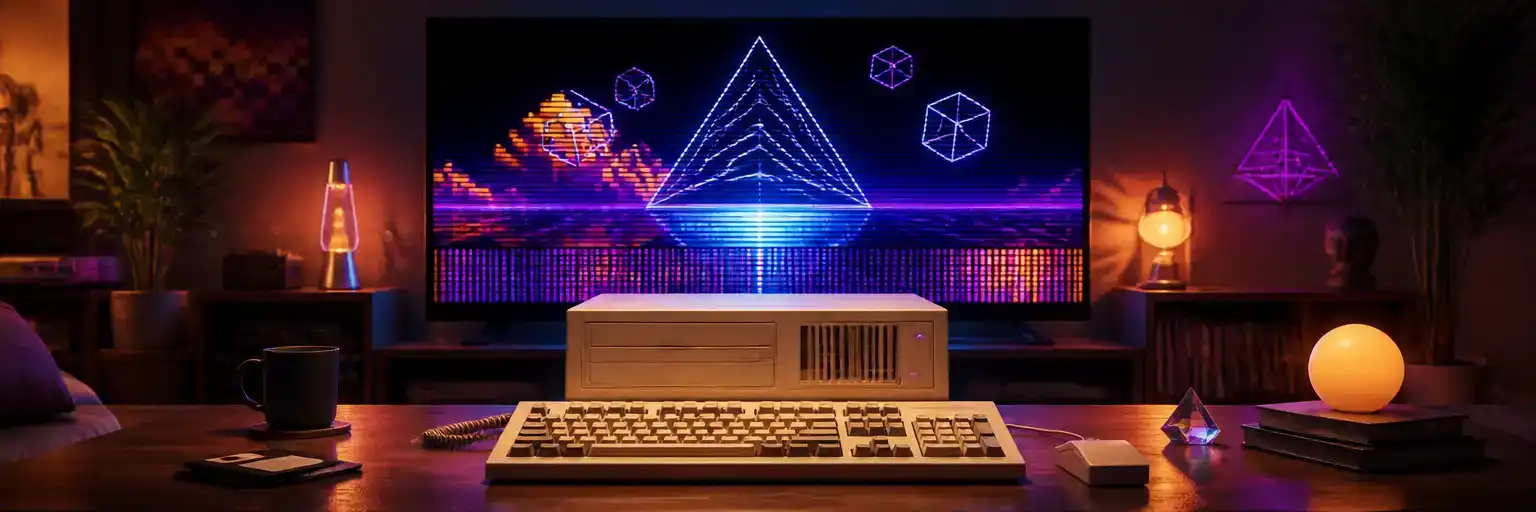
AI-generated image
How many cyberdecks have you seen that you could imagine someone writing an email on? Not posing next to, not filming for a thumbnail, but actually sitting down with for a workday. The question is a little unfair, and it is exactly why the Slurptop is worth a column.
A cyberdeck built for practical work is a rarer thing
Hackaday describes two kinds of cyberdeck: the kind made on a lark and run purely on "rule of cool," and the kind designed to do practical work. The Slurptop, by Slurpburgers, lands in the second camp. It is a custom laptop with an ergonomic mechanical keyboard and a trackball, powered by power-tool batteries. Hackaday says the battery lasts about four hours, and that swapping is easy but not hot-swappable.
Unlike many DIY decks, which are built on Raspberry Pi boards, TechPowerUp notes that this one uses a full-fat AMD Ryzen 7 7730U. Hackaday describes the machine as running on an x86-based GMKtec MiniPC.
The prop is the easy part
Building something that looks like a cyberpunk film set is, frankly, the easy path. Exposed wiring, a tiny screen and a few glowing parts photograph well and ask little of the machine. Nobody has to find out whether the keyboard is comfortable after three hours or whether the battery survives a morning.
Practical work is a harsher judge. It exposes every compromise. The Slurptop has some, and Hackaday is candid about them: no hot swapping, and charging only on the factory charger rather than in the device. We find those flaws reassuring. A prop has no flaws worth mentioning, because nobody depends on it. A tool has annoyances because someone is actually living with it.
We should be fair to the other side. Hackaday's own pages show builds like the Altoids-tin TN Deck, which the site describes as made for the love of the game, and its builder admits the keys don't have much travel and the ergonomics aren't the best. It is a lovely piece of craft. Rule-of-cool is not a sin, and tiny, impractical showpieces are often where the cleverest tricks appear, like that build's printed drill guide. Our complaint is narrower: when it is the only thing the scene celebrates, the word "cyberdeck" stops meaning anything.
Why power-tool batteries are the smartest idea here
The most interesting choice isn't the Ryzen chip. It's the battery. Hackaday suggests this brings the Slurptop closer to the Neuromancer sense of the word, with its "assemble from off the shelf components at need" vibe, and says it can't recall a cyberdeck made with tool batteries before.
We'd go a step further, as opinion: a battery format that already exists in workshops everywhere is a more honest answer to portability than a custom pack. It is standardized, replaceable and probably already in the maker's garage. The UPS module used to switch to wall power follows the same logic: borrow proven parts, then bolt them together. That is the real cyberpunk attitude, scavenging, not styling.
The Hackaday writer also asks why laptops ever stopped carrying mechanical keyboards and trackballs. We share the question. The Slurptop's inputs are praised as glorious, and the trackball is a minor hack made from the guts of an old gaming mouse. The lesson, we think, is that a personal machine can be shaped around your hands, not around a manufacturer's thinness target.
A Pi is not the point, and neither is the Ryzen
None of this is an argument against the Raspberry Pi. Official guidance exists, and TweakTown reported that Raspberry Pi published a step-by-step guide by Brian Corteil for a portable, weatherproof cyberdeck using a Raspberry Pi 5. A Pi is a perfectly sensible base for many jobs. The Slurptop simply shows that the chip should follow the task. If your work needs x86 and real horsepower, a mini PC board is the honest choice.
That is the verdict we'd give anyone starting a build: decide first what you will do with it every day, then choose the parts. If you can't name the job, you are probably making a prop, and that's fine, but call it one.
The Slurptop's four-hour battery and awkward charging won't convince everyone, and Hackaday itself says not everyone will approve of every design choice. That is the point of building your own. What the scene should copy is not the tool batteries or the trackball. It is the willingness to make something you will be annoyed by on a Tuesday, because you used it on Monday.
No topics yet: start the first one.
More stories
MustardOS Andromeda proves handhelds get their soul from the community
A community-built firmware just shipped roughly 1,250 changes for cheap retro handhelds. Manufacturers should stop treating that as a threat and start treating it as the product.

The A1200 at 190 euros: judge it by what it lets you do
A full-size Amiga 1200 remake for about 190 euros is welcome, but the badge isn't the point: openness, hackability and the game library decide if it's a real Amiga.
The 110 revival is real, but digital lookalikes sell the look, not the limit
Camp Snap and Flashback are selling the silhouette and the ritual of old film cameras. What made 110 creative was a constraint no sensor skin can reproduce.
If an AI won't root your TV, who really owns the TV?
Reports say Claude Opus 5.5 balks at rooting smart TVs. Unconfirmed, yes, but the real question is whether safety filters can coexist with the right to tinker.