Rebuilding a 1996 PC is a quiet protest against AI-priced hardware
A YouTuber's jumper-setting, 2GB-drive nostalgia build is more than sentiment: it's a rational retreat from a market where AI demand squeezes memory, GPU and storage.
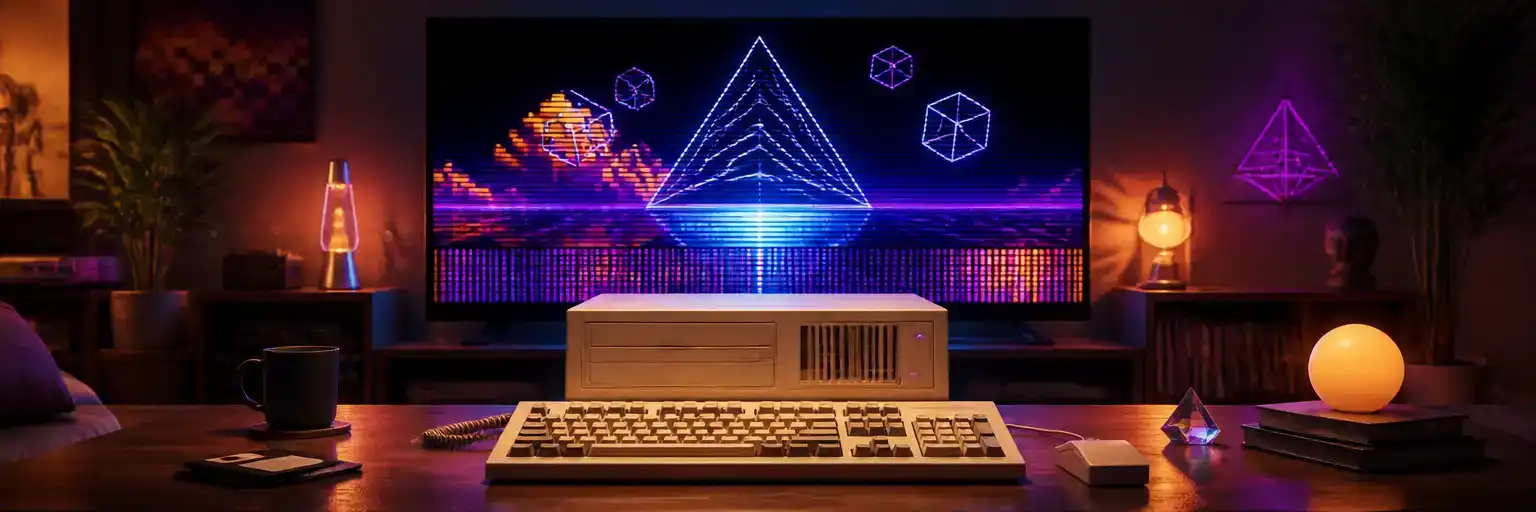
AI-generated image
What does it say about the PC market when building a computer from 1996 looks like the sane option? Not the fast option, not the smart one by any benchmark. The sane one.
That's the question hiding inside a video from the YouTuber TrashBench. As Tom's Hardware reports, he recreated the first PC his parents bought him in 1996, the one he used to play The Need for Speed: Special Edition: a Pentium MMX 200 MHz on an Epox motherboard, 32 MB of RAM, a Western Digital Caviar with two gigabytes, a Sound Blaster 16 and, eventually, a Matrox Mystique 3D. The article frames the whole thing as an escape from a tech market where memory, graphics cards and now storage are "becoming impossible to obtain" and AI is everywhere.
Nostalgia is the cover story; price is the plot
Calling this a nostalgia trip is accurate and also a little lazy. People have always rebuilt their childhood machines. What's new is the timing, and we think the timing is the argument.
Consider what buying a modern PC looks like right now. One market analysis, from the retailer Magic Micro (a seller, so read it with that in mind), says contract DRAM pricing rose roughly 170% cumulatively by mid-2026, and that analysts expect finished GPU prices to climb 20–30%. It also reports that Intel's CEO has said meaningful relief may not arrive until 2028. Those are claims from an interested source, but they match the mood of the whole coverage.
Against that backdrop, a machine that is a known quantity, with every part understood, is not a retreat from the future. In our view it's a hedge. When the new thing costs more and the old thing is predictable, a hobbyist can be forgiven for ceasing to chase.
The jumpers are the point
The detail that stuck with us is the jumpers. The motherboard needed them set by hand for CPU speed and voltage, and Tom's Hardware notes you could burn out a CPU by playing the jumper game wrong. The hard drive needed a jumper too, to clip its capacity because BIOSes and controllers of the time couldn't address more.
That sounds like a hassle, and it was. But look at what it means: every limitation was visible, physical and yours to change. You could point at the thing that decided how the machine behaved. Compare that with today's hardware, where, as we see it, price and supply are decided far upstream, by data-center contracts you'll never see.
This is what hobbyists actually value and rarely say out loud: an understandable machine. Not nostalgia for slow, but nostalgia for legible. A 40 mm fan that's enough, no case cooling because none is needed, a drive loud enough that you know it's working. The machine explains itself.
We should be careful not to romanticize. The same article is honest that the S3 Trio32 had no 3D capability, the Matrox was of "dubious quality," and the joystick needed replacing in about six months. Nobody should pretend 1996 was a golden age of reliability. It wasn't.
The AI tax is a cultural cost, not only a financial one
Here's where we'd push the thesis a bit further. The money matters, but the deeper damage is to the sense that a PC is yours to build. One source, shattered.io, says AI data centers may soak up around 70% of high-end memory output this year (an industry estimate, and the page is undated, so treat it as a soft number). Even so, the direction is plausible.
When the part you need most competes with hyperscalers for supply, building your own PC risks becoming less a way to save money and more a way to pay a premium for the privilege. That would invert the old deal that made the DIY scene what it is. Of course people are looking backward.
This also sits well with what the retro and demoscene crowd has always known: constraints are a creative space. A fixed 32 MB of RAM and a 2 GB disk force decisions that unlimited resources never do. We wouldn't be surprised if more people discover that.
Our verdict
Don't read this video as a sad shrug at the present. Read it as a signal. If you're tired of the market, a period-correct build is an instructive and rather joyful protest: we'd bet you'll learn more about how a computer works from one afternoon with jumpers than from a year of buying sealed parts.
But be realistic. It won't change prices, and nobody is going back to a Pentium for daily work. What it can do is remind manufacturers, and ourselves, that the appeal of the PC was never raw specs. It was that you could open it, understand it and make it yours. The industry should worry when its most devoted customers find that easier in 1996 than in 2026.
No topics yet: start the first one.
More stories
MustardOS Andromeda proves handhelds get their soul from the community
A community-built firmware just shipped roughly 1,250 changes for cheap retro handhelds. Manufacturers should stop treating that as a threat and start treating it as the product.

The A1200 at 190 euros: judge it by what it lets you do
A full-size Amiga 1200 remake for about 190 euros is welcome, but the badge isn't the point: openness, hackability and the game library decide if it's a real Amiga.
The 110 revival is real, but digital lookalikes sell the look, not the limit
Camp Snap and Flashback are selling the silhouette and the ritual of old film cameras. What made 110 creative was a constraint no sensor skin can reproduce.
If an AI won't root your TV, who really owns the TV?
Reports say Claude Opus 5.5 balks at rooting smart TVs. Unconfirmed, yes, but the real question is whether safety filters can coexist with the right to tinker.