Dollhouse DOS: Redefining Retrocomputing with Miniature Charm
Juha Lilja's Micro DOS arcade cabinet for dollhouses, streaming games over Wi-Fi, transcends traditional emulation to become a delightful, functional art installation that challenges our understanding of computing.
AI-generated image
What happens when the nostalgic pull of classic DOS games meets the intricate world of dollhouses? The answer, as recently unveiled by Juha Lilja in a 2026 Retrocomputing Challenge, is a fascinating redefinition of what retrocomputing can be. This isn't merely about shrinking down old tech; it's about imagining entirely new ways to engage with digital history, proving that functionality can be as much about concept as it is about brute force processing.
Lilja's creation, dubbed the Micro DOS arcade cabinet, is a marvel of miniature engineering. It’s a tiny stand-up arcade unit designed to fit perfectly within a dollhouse, yet it promises to deliver classic DOS gaming. The ingenious twist, as Hackaday reports, is that the cabinet itself “runs nothing.” Instead, it functions as an embedded remote terminal, streaming games wirelessly over Wi-Fi from a nearby PC. Inputs are equally imaginative: the entire cabinet tilts to act as a virtual joystick, while button presses are registered by tapping the physical screen, supporting single, double, and long-clicks. This elegant solution keeps the unit self-contained and avoids the complexity of installing minuscule traditional controls.
Beyond Emulation: The Art of the Impractical
For many, retrocomputing is synonymous with emulation—the painstaking recreation of historical hardware environments to run software as authentically as possible. Think of projects that meticulously reconstruct old systems or the widespread use of software emulators to play vintage titles. However, Lilja's Micro DOS cabinet suggests a departure from this strict adherence to authenticity. This project isn't about perfect pixel ratios or cycle-accurate timing; it's about the idea of a DOS arcade cabinet in an unexpected context. It's functional art, embracing the impracticality of its scale to evoke a sense of wonder and imaginative play. The technical details —an M5Stack AtomS3R handling display and input for a remote backend— serve the aesthetic and conceptual goals, rather than dominating them. We view this as a powerful statement: retrocomputing doesn't always need to be a quest for historical exactitude; it can also be a canvas for creative expression, blending digital nostalgia with physical artistry.
Redefining "Hardware" in Miniature
Traditional hardware, especially in the context of arcade cabinets, implies a self-contained system where all processing and display occur within the unit.
No topics yet: start the first one.
More stories
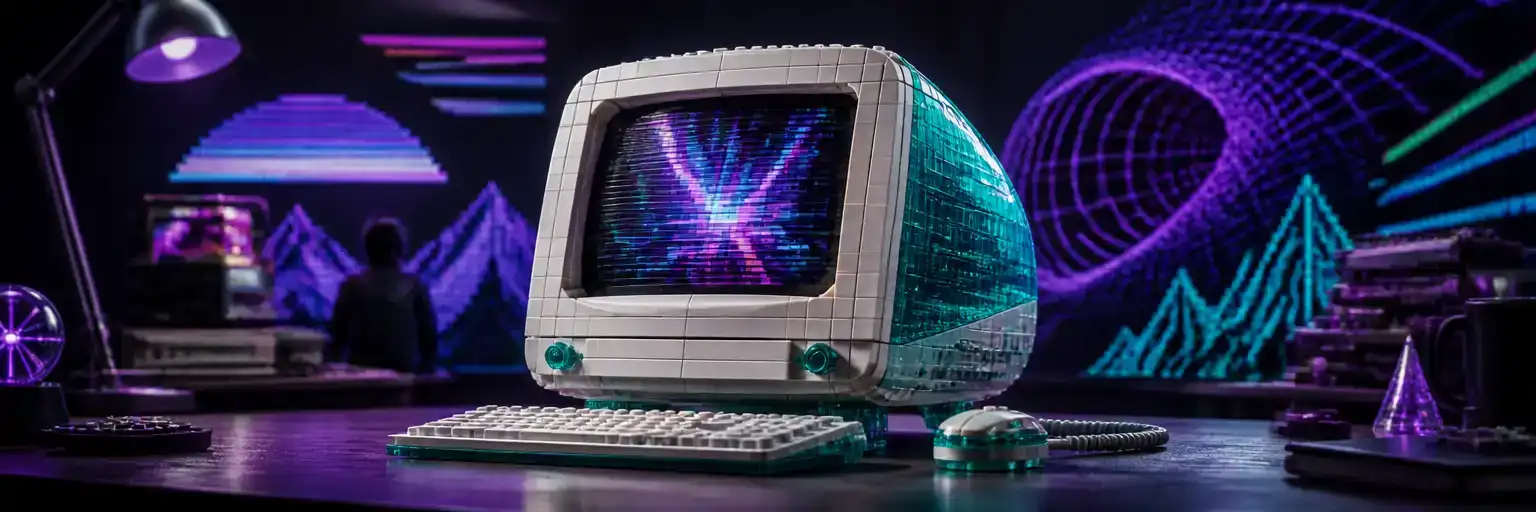
Why the iMac G3 LEGO project is more than just nostalgia
The community-backed initiative to immortalize the iconic Apple iMac G3 in LEGO bricks is not merely a trip down memory lane, but a powerful affirmation of design's lasting influence and a catalyst for digital art's future.
Flash Games: The Unsung Blueprint for Accessible Creative Coding
The remarkable resurgence of archived Flash games reveals a pivotal moment for creative coding and browser-based experiences, underscoring the enduring power of accessible tools and dedicated digital preservation.

PS5 Emulation on Xbox: A Boundary-Breaking Technical Statement
The surprising development of PlayStation 5 games booting on Xbox Series X via emulation is a testament to the open-source community's ingenuity, signaling a future where console boundaries blur and preservation efforts gain unprecedented visibility.

Community Ports: The Essential Architects of Retro Gaming's Future
Community-driven recompilations and native ports are not merely about reliving nostalgia; they represent the most dynamic and critical force ensuring classic games endure against technological obsolescence and proprietary barriers.