A shiny retro box is not a platform: keep the C64 and Amiga hackable
The 2026 wave of C64, Amiga 1200 and N64 revivals is welcome, but only open slots, loadable software and living scenes turn nostalgia merchandise into a platform.
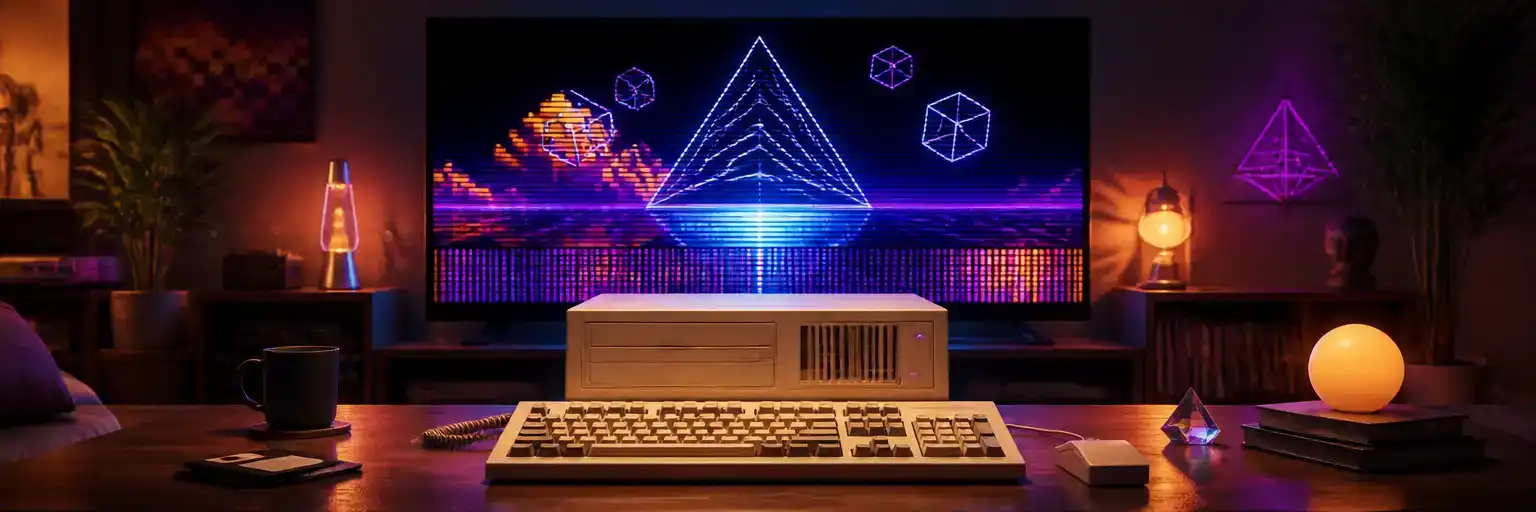
AI-generated image
Is a retro revival a product or a community? Every time a beloved beige computer comes back in a new shell, the marketing says the first, and the people who actually kept these machines alive for decades hope for the second. We think the answer decides whether 2026's retro boom is a lasting event or a well-packaged shelf ornament.
The 2026 retro boom is messier than the headlines
PCGH calls 2026 surprisingly full for retro fans, from a C64 handheld to the Amiga 1200 and the Nintendo 64. The details are less tidy than that. Blaze Entertainment and Retro Games Ltd announced clamshell handhelds for the C64 and the Spectrum at £109.99 | $129.99 | €129.99, with 25 built-in games and a MicroSD slot.
Then, according to Time Extension, Blaze moved the release from October 15, 2026 to April 22, 2027, citing construction that did not meet its standards. The Evercade Nexus, which aims at N64-era games, is still expected on October 30, 2026. And TheA1200, the full-size Amiga 1200 remake, was pushed to December 4, 2026, per a retro gaming newsletter.
The slot matters more than the shell
Of everything in the C64 handheld's spec sheet, the line we care about most is not the 4.3-inch screen. It is the MicroSD slot, which lets you bring your own games, plus the USB-A port for a keyboard. The press release also promises options for system speeds and audio chip selection. That is the difference between a toy and a tool.
The preloaded list is telling too: it mixes classics like Boulder Dash and Paradroid with new titles, and a retail listing says those come from the modern independent development scene. We read that as the right instinct. If the box ships current indie work next to 1980s classics, it implicitly admits that these computers never stopped being written for.
Our stance: judge every revival by what happens after unboxing. Can you run your own code? Can a new release from a scene group land on it without a license negotiation? A sealed cartridge-only machine is a jukebox. A machine with open storage and keyboard support is at least a doorway.
An Amiga that runs Workbench is a better promise
The Amiga 1200 case is more interesting. Der Standard's coverage is headlined "Amiga-Comeback mit Workbench" and describes the A1200 as a fully functional emulator that includes a port of Die Siedler II, and as not just about gaming. That framing matters. A desktop environment invites tinkering in a way a game menu does not. We also note that Retro Games has said the system will carry Amiga branding, which suggests the licensing situation is moving in a helpful direction, though we would not read more into it than that.
The delays are the part we would not overreact to. A late product is annoying, but a rushed one that arrives with a flimsy build would be worse for trust. We give Blaze credit for choosing April 2027 over shipping something it was unhappy with, even if pre-order customers are entitled to be grumpy.
What the scene should demand
Here is where we get opinionated. Nostalgia hardware sells to people who remember, but demoscene culture is made by people who write, compose and compete today. Revival makers get a free ride on that culture's history, so the scene should ask for something back. Documented behavior, honest emulation settings, easy file loading and no lock-in would be a start. Official support for new releases would be better.
There is a risk on the other side as well. A glossy product can quietly replace the community as the public face of a platform. Newcomers meet the C64 as a £109.99 handheld, not as a machine with a living party circuit. That is only a problem if the scene fails to meet them at the door.
Our verdict
Buy the revivals you like, but buy the open ones first. Prefer devices with a slot, a keyboard port and system options over pure display pieces, whatever extras come in the box. Retro makers deserve applause for putting these names back on shelves. They will deserve more if, a year from now, the most interesting thing running on their hardware was not in the box.
No topics yet: start the first one.
More stories
MustardOS Andromeda proves handhelds get their soul from the community
A community-built firmware just shipped roughly 1,250 changes for cheap retro handhelds. Manufacturers should stop treating that as a threat and start treating it as the product.
The A1200 at 190 euros: judge it by what it lets you do
A full-size Amiga 1200 remake for about 190 euros is welcome, but the badge isn't the point: openness, hackability and the game library decide if it's a real Amiga.
The 110 revival is real, but digital lookalikes sell the look, not the limit
Camp Snap and Flashback are selling the silhouette and the ritual of old film cameras. What made 110 creative was a constraint no sensor skin can reproduce.
If an AI won't root your TV, who really owns the TV?
Reports say Claude Opus 5.5 balks at rooting smart TVs. Unconfirmed, yes, but the real question is whether safety filters can coexist with the right to tinker.